



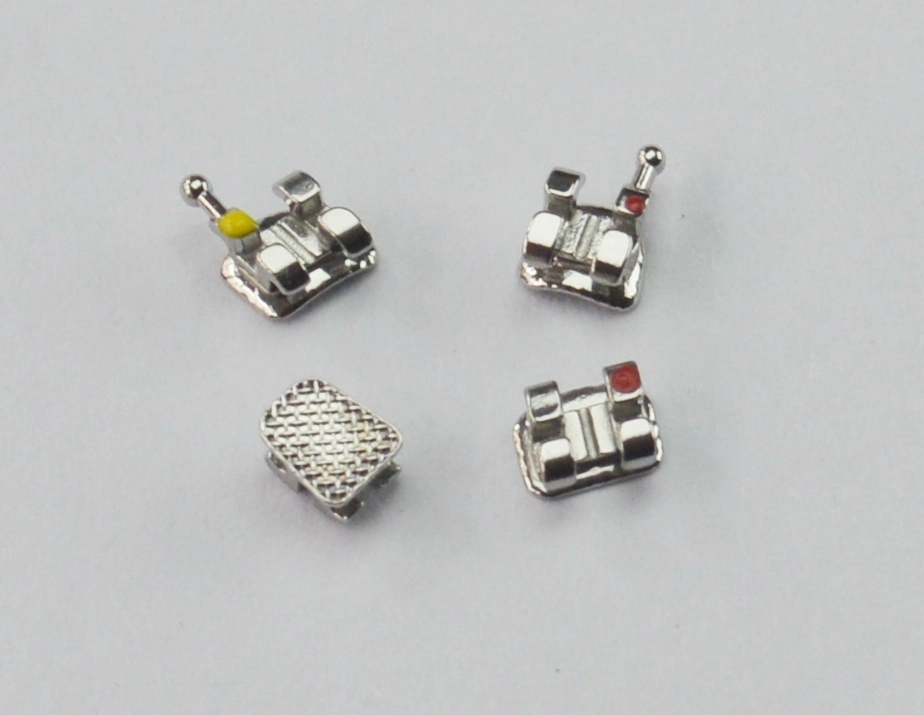
MIM Metal Brackets Used For Orthodontic Treatment
Orthodontic brackets are typically manufactured from metal, ceramic, or polymer materials. They generally feature a slot and ligature wings, with some models including traction hooks. Their primary function in orthodontic treatment is to receive and transfer orthopedic forces from the archwires.As a mainstream appliance in clinical orthodontics
Product Description
Orthodontic brackets are typically manufactured from metal, ceramic, or polymer materials. They generally feature a slot and ligature wings, with some models including traction hooks. Their primary function in orthodontic treatment is to receive and transfer orthopedic forces from the archwires.
These brackets are equipped with an 80-mesh base and are fabricated using Metal Injection Molding (MIM). The bracket body and base are joined via precision welding technology, ensuring excellent bonding strength. As a mainstream appliance in clinical orthodontics, they offer high strength and good toughness. Bonded to the tooth surface and used in conjunction with orthodontic archwires and accessories, they apply gentle therapeutic forces to correct issues such as crowding, misalignment, protrusion (buck teeth), and malocclusion, thereby improving tooth alignment and occlusal function. They are indicated for use on teeth #1 through #5.
Brackets are categorized into two main types: monoblock and bondable. Both types are available in standard and mini sizes. Furthermore, both sizes come in three prescription systems: Roth, MBT, and Edgewise. Regarding hook configurations, they are available in three options: no hooks, hooks on tooth #3, and hooks on teeth #3, #4, and #5.
Product Model List
| TYPE | SLOT | no hooks | 3-hooks | 345hooks | |
| MINI | ROTH | 0.022 | MR22-0 | MR22-3 | MR22-345 |
| 0.018 | MR18-0 | MR18-3 | MR18-345 | ||
| MBT | 0.022 | MM22-0 | MM22-3 | MM22-345 | |
| 0.018 | MM18-0 | MM18-3 | MM18-345 | ||
| EDGEWISE | 0.022 | ME22-0 | ME22-3 | ME22-345 | |
| 0.018 | ME18-0 | ME18-3 | ME18-345 | ||
| STANDARD | ROTH | 0.022 | SR22-0 | SR22-3 | SR22-345 |
| 0.018 | SR18-0 | SR18-3 | SR18-345 | ||
| MBT | 0.022 | SM22-0 | SM22-3 | SM22-345 | |
| 0.018 | SM18-0 | SM18-3 | SM18-345 | ||
| EDGEWISE | 0.022 | SE22-0 | SE22-3 | SE22-345 | |
| 0.018 | SE18-0 | SE18-3 | SE18-345 |
Types Of Brackets
Brackets are classified into stainless steel, ceramic, and sapphire according to their materials
Main Purpose
Mainly used for orthodontic treatment, it is pasted on the surface of teeth, combined with orthodontic archwires and attachments, to apply gentle corrective force, correct problems such as crowded teeth, misaligned teeth, crooked teeth, and bite disorders, and improve tooth alignment and bite function.
Advantage
High hardness, stability and durability, strong correction force, wide adaptability, easy maintenance and replacement, it is a classic choice for traditional orthodontics.
Product Features
Excellent Material:
Made of medical grade stainless steel alloy, it is corrosion-resistant, biocompatible, safe and non-toxic, and can be worn for a long time.
Structural design:
Smooth and exquisite surface, precise grooves, and even force distribution; The lock groove design facilitates the fitting of the archwire and ensures stable correction force.
Efficient orthodontic treatment:
high hardness, deformation resistance, strong load-bearing capacity, efficient tooth movement, stable orthodontic cycle.
High cost-effectiveness:
Durable and not easily damaged, easy to install and disassemble, economical and practical, suitable for a wide range of people.
Complete styles:
divided into ordinary metal brackets and self-locking metal brackets, with complete specifications, suitable for various orthodontic cases.