



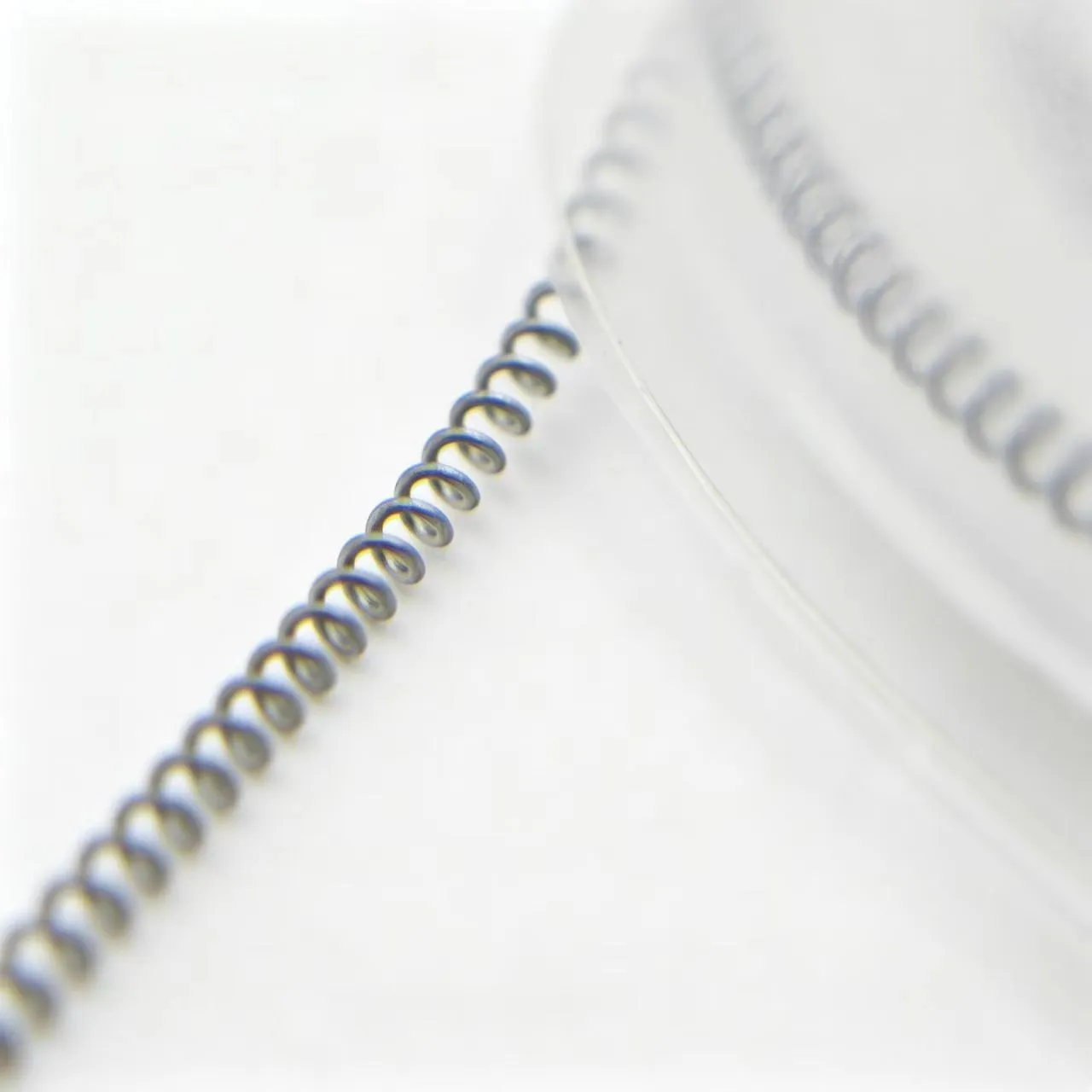
NiTi Open Sprigns Expand The Gap BetweenThe Teeth
Product Description
A spring typically consists of coil hooks, the spring itself, and connecting components between the hooks and the spring. It is used to correct dental malocclusions and works in conjunction with orthodontic materials like implant anchorage and orthodontic brackets during treatment.
Dental NiTi push springs are commonly used fixed elastic force-delivering components in orthodontic clinics. Made of NiTi alloy, they feature superelasticity, shape memory, gentle and continuous force delivery, and a wide range of deformation.They are primarily used for pushing teeth, opening spaces, and distalizing teeth in orthodontic alignment.
These springs are available in 4 models and 2 lengths, with packaging options including individual pouches and rolls. Different models correspond to different force levels.
Core performance characteristics
1. Super elastic constant force
The strength is gentle, continuous, and decays slowly, avoiding the sudden force of rigid springs and reducing root resorption and patient soreness.
2. Shape memory effect
Repeated compression is not prone to permanent deformation, with stable rebound and long service life.
3. Good flexibility
Can adapt to slight twisting and irregular arrangement of dental arch segments, and fit the bracket track.
4. Good biocompatibility
Resistant to oral moisture, acidic and alkaline environments, corrosion-resistant, and not
Principle of action
The nickel titanium push spring is installed between two arch wires/brackets, using the continuous elastic force of compression rebound to generate a pushing force on both sides of the teeth,
Product Model List
| Open Sping | Size(inch) | Strength(g) | Length(mm) | package |
| Superlight | 8 | 100 | 180mm 910mm |
2pcs 1spool |
| Light | 10 | 150 | ||
| Medium | 12 | 200 | ||
| Heavy | 14 | 250 |
Clinical usage method
1. Place it in the bracket groove of the square/round wire, between the two teeth that need to be separated
2. Cut the appropriate length, compress and place it in place, and press both endsagainst the bracket/blocking tube
3. Fix with ligature wire and elastic ligature ring to prevent sliding and falling off
4. Regular follow-up check for elasticity and tooth movement, and replace or adjust the length if necessary